Hearts: A Craft Fair-Ready Embroidery Design
First Impression: Bright, Cheerful, and Instantly Recognizable
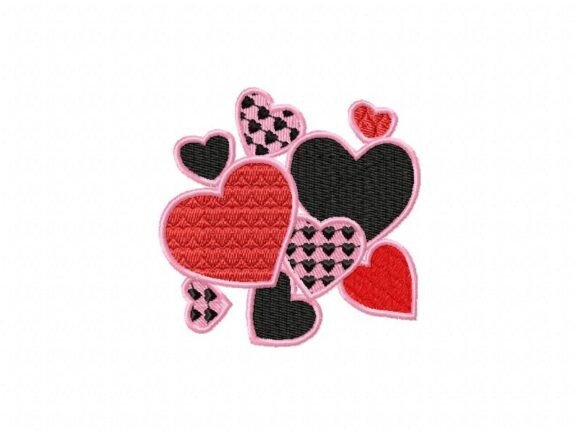
Hearts lands with unmistakable energy—vivid, effervescent, and unapologetically cheerful. It’s not delicate or minimalist; it’s a bold, friendly statement that reads *joy* at six feet. That makes it ideal for craft fairs, where attention spans are short and visual impact is everything. Customers don’t pause to decode subtlety—they gravitate toward warmth, color, and emotional resonance. Hearts delivers all three. It leans modern-cute rather than rustic or vintage, so it pairs beautifully with clean-lined tote bags, crisp aprons, and contemporary pillow covers—not farmhouse tea towels or distressed denim.
Where Hearts Shines on Craft Fair Products
On a crowded booth table, Hearts stands out strongest when placed intentionally—not as filler, but as focal punctuation. Here’s how it performs across key handmade products:
- Tote bag design: Centered on the front panel or scaled slightly larger on the bottom third? Perfect. The heart’s symmetry and saturated color pop against natural canvas or heather gray.
- Apron embroidery: Top-left chest placement (above the pocket) gives instant charm without overwhelming utility. Works especially well on light-to-midweight cotton—no puckering, no distortion.
- Tea towel embroidery: Use with caution. On tightly woven, smooth linen-look towels? Yes. On thick, textured terry or looped cotton? Avoid—it risks muddying stitch definition and losing vibrancy.
- Embroidered patch: An excellent candidate. Hearts scales cleanly down to 2.5"–3", holds shape well, and reads clearly even when sewn onto denim jackets or backpacks.
- Fabric pouch & small market bag: Ideal for side-panel accents or centered front motifs. Its compact shape fits naturally within standard hoop sizes and avoids awkward stretching on curved seams.
- Pillow cover & cap embroidery: Performs reliably on flat panels. On curved cap surfaces? Test first—dense fill areas may shift if digitized without curve compensation. Not recommended for low-profile structured caps unless confirmed compatible.
What Makes Hearts Sell—And What Requires Care
Hearts earns its place in your craft fair lineup because it’s instantly legible, emotionally inviting, and versatile across age groups and styles. Buyers connect quickly: “That’s sweet,” “That’s my color,” “I’d gift that.” That emotional hook translates directly to impulse purchases—especially on small shop products like patches, pouches, and mini pillow covers.
But clarity isn’t automatic. As an embroidery designer, I always ask: Does this hold up under real-world conditions? Hearts is forgiving on smooth, stable fabrics—but watch for these practical limits:
- Dense stitch areas: The center fill of the heart may compress on heavy stabilizer or thick fabric—test on scrap before batch production.
- Small lettering or fine lines: None present—good. Hearts relies on shape and saturation, not detail. That means it stays sharp even at 2" wide.
- Dark fabric: Thread colors matter. If your version uses light-toned threads (e.g., pastel pinks, yellows), contrast drops significantly on navy or charcoal. Always verify thread contrast on your target fabric swatches.
- Fabric texture: Avoid highly napped, shaggy, or loosely woven textiles—stitch definition blurs fast. Stick to medium-weight quilting cotton, twill, linen blends, and smooth canvas.
Photography, Listings, and Online Appeal
Hearts photographs exceptionally well—its color saturation and clean outlines translate powerfully to Etsy listings and printable mockups. No need for heavy filters or staging tricks. A simple flat-lay on white marble or warm wood shows off its vibrancy and craftsmanship. For digital sellers, include at least one lifestyle photo (e.g., embroidered on a tote held by hand) to signal handmade quality and scale. Because Hearts is part of the Freebies collection, it’s also a smart lead magnet—offer it as a download with newsletter sign-up to grow your email list while building trust with fellow Etsy sellers and boutique makers.
Production Practicality: Speed, Consistency, and Batch Confidence
This is where Hearts earns serious respect. As a machine embroidery design, it’s inherently repeatable. Minimal jump stitches, logical color sequence, and balanced stitch density mean fewer thread breaks, less re-hooping, and smoother transitions between items—even across different fabric types. You can confidently run 20+ tote bags back-to-back without redesigning tension or repositioning hoops. That consistency builds booth credibility: when five identical hearts look equally vibrant and precise, customers read *professional*, not “hobbyist.”
Designer Notes You Can’t Skip
Before cutting fabric or loading your embroidery file, do these six things:
- Test the design on scrap fabric matching your final product’s weight and weave.
- Check thread contrast—especially if stitching on dark or black fabric.
- Review spacing and alignment: does the heart sit comfortably within your chosen hoop size? Does it clear seam allowances and edges?
- Inspect stitch density—does the fill area breathe, or will it stiffen lightweight fabric?
- Use the right stabilizer: cutaway for stretchy knits, tear-away for stable wovens, and fusible + tear-away combo for textured tea towels.
- Create at least one real mockup—not just a digital preview—and hold it in natural light. Compare how it looks on cream vs. oat vs. slate fabric.
And one final reminder: Hearts is labeled as Embroidery—but if you plan to sell finished products commercially (e.g., embroidered totes on Etsy), confirm commercial licensing applies to your use case. Don’t assume “Freebies” means unrestricted resale rights. When in doubt, reach out to the source for written confirmation.
Final Thought: Hearts Is Booth Fuel
In the rhythm of a weekend craft fair—where buyers skim, touch, compare, and decide in seconds—Hearts doesn’t whisper. It smiles, invites, and lingers. It lifts the perceived value of a simple tea towel, adds personality to a plain cap, and transforms a basic pouch into a giftable handmade product. It’s not just an embroidery file. It’s visual shorthand for care, color, and connection. And for creative entrepreneurs who know that every stitch tells a story? Hearts tells one worth repeating.